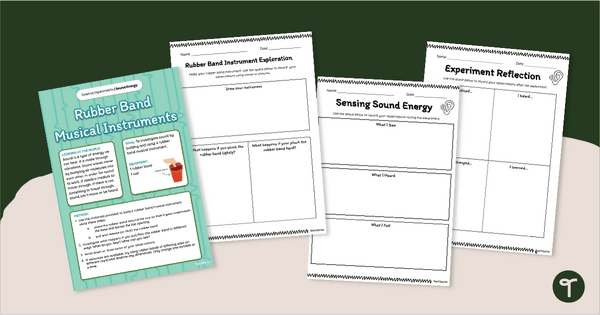
Use this sound energy experiment to help your students create rubber band instruments and visualise sound using everyday items.
🔍 Discovering Sound Energy with Rubber Band Musical Instruments
This Rubber Band Musical Instruments sound investigation is designed by our teacher team for individual students, pairs, or small groups, making it adaptable to various classroom settings. You could even use this Rubber band musical instrument activity as a rotation, or demonstrate it yourself as a whole-group lesson.
How to Conduct Your Sound Energy Lesson
All you’ll need for this project is the resource template, which you can download in printable PDF or Google Slides format, and a rubber band and paper cup for each student, group, or pair. Before you begin, it is a good idea to emphasise the importance of securely attaching the rubber bands to the cup before flicking to ensure a safe and controlled experiment.
From there, just follow these simple steps (which are also outlined on the project page for your students to read and follow):
-
- Place the rubber band around the cup, ensuring it goes underneath the base and across the top opening.
- Pull and release (or flick) the rubber band. Observe and listen keenly – what sounds do you hear? What visual effects can you detect?
- Experiment with different methods of pulling or flicking the rubber band. Document your observations through writing or drawing.
- If resources permit, try using rubber bands of different sizes or experimenting with various cups. Remember, change only one variable at a time to observe the impact.
Encourage Students to Make and Record Their Observations
Encourage students to reflect on the outcomes of the activity. How does this experiment allow them to ‘see’ sound? Prompt them to consider the visual and auditory aspects to foster a deeper understanding of the connection between vibrations and sound perception.
This resource not only engages students in a fascinating exploration of sound but also encourages scientific inquiry and critical thinking. Dive into the world of rubber-band resonance and empower your students to unravel the mysteries of sound waves in a fun, interactive way!
This resource was created by Brittany Kellogg, a teacher and Teach Starter collaborator.
On the Lookout For More Great Sound Energy Lesson Ideas?

0 Comments
Write a review to help other teachers and parents like yourself. If you'd like to request a change to this resource, or report an error, select the corresponding tab above.