

World Poetry Day comes around just once a year — always on March 21. Yes, we know National Poetry Month is coming up fast in April … and there seems to be a day for everything, everyone, and their horse. All that said, World Poetry Day is a great reason to incorporate a little creative poetry lesson into your day, even if your students aren’t in the middle of a poetry unit.
There are so many benefits that come out of making creative tasks like writing poetry a more regular part of your students’ learning experiences. By just giving them time to engage with creative writing sends the message that their own creativity really does matter!
World Poetry Day Activities
Watch a Poetry Slam
If you haven’t yet engaged in the world of slam poetry, then prepared to be amazed! Slam Poetry is a form of performance poetry that brings life to stories, ideas, and words through the use of voice (and sometimes movement too!). Slam poetry is, quite possibly, the BEST way to introduce your students to the world of poetry!
Meet a Young Poet
There’s nothing quite like seeing kids who aren’t much older than them featured in a lesson for students to perk up their ears. Introduce your class to Solli Raphael, a 13-year-old boy from the East Coast of Australia, and he’s the youngest ever winner of the Australian Poetry Slam. Share this amazing Solli Raphael poem about harmony and equality with your students.
After meeting Solli and watching some of his work, challenge your students to begin writing their own piece of slam poetry about something they are passionate about!
Write an All About Me Poem
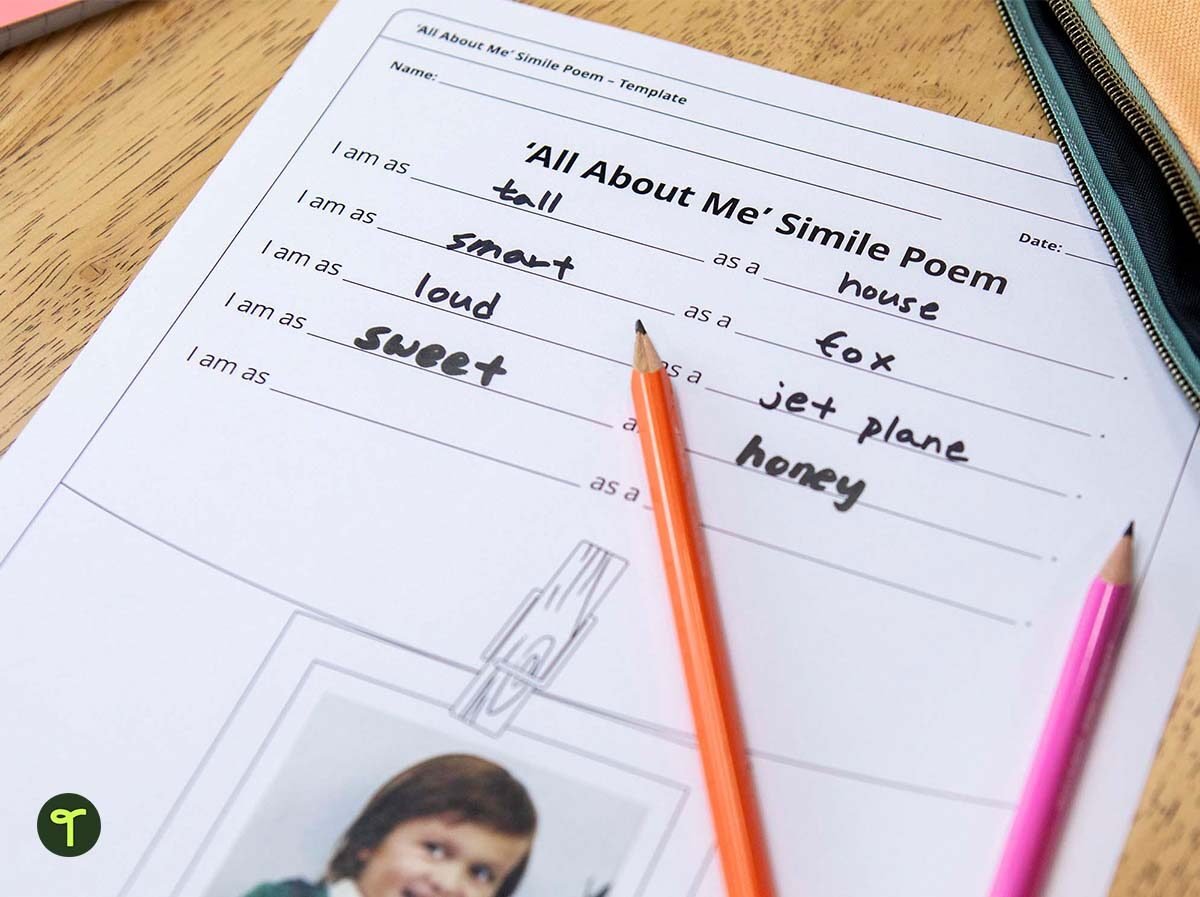
Amplify their figurative language lessons with a fun “like” and “as” all about me simile poem using this printable simile poem template! Are they as smart as a fox? As colorful as a rainbow?
Create a Poetry Performance
Download, and print out this awesome Poetry and Figurative Language Workbook. You’ll find it contains four wonderful original poems. Your students can use these poems to create a short poetry performance to share with their class!
- Break your class into small groups (approximately 3-5 students works well).
- Provide each group with one of the poems from the workbook. Don’t worry if more than one group has the same poem. It will be just as fun to see what different groups create with the same stimulus!
- Support students in developing a short poetry performance piece. Begin by discussing the possible ways they could perform their poem to the rest of the class:
– Groups could have a single narrator read out the poem while the rest of the group act it out.
– Students could each take on a role from within the poem (remember, roles don’t have to be people, students can use movement to act out things from nature or even inanimate objects that might come to life!) and act out the story.
– Students could use the poem as inspiration and create a little scene that shows another situation related to the original poem (e.g. using “The Poet’s Lament” students could create a short performance that shows a young person who hates writing poetry, but then turns up to find that everyone at school now speaks in rhyme!) - Have each group present their short performance to the rest of the class.
Here’s a little tip for managing the ‘performance time’ part of this lesson. While the performing group is setting themselves up to begin, ask the rest of the class to close their ‘budget curtains’ (close their eyes, or place their hands over their eyes so they can’t see what’s happening on the ‘stage’ – just as though the curtain was closed in a real theatre!). When the performing group is ready, count down “3, 2, 1, Action!” and let the audience open their ‘budget curtains’ as the performance begins!)
For more printable teaching resources and lesson ideas, check out our Poetry Teaching Resource Collection!
Banner image via shutterstock/wavebreakmedia



Comments